


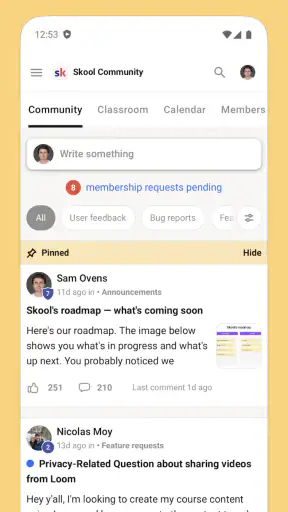
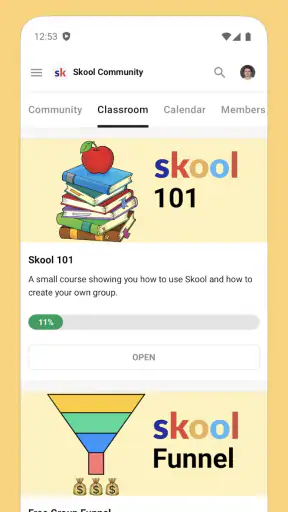
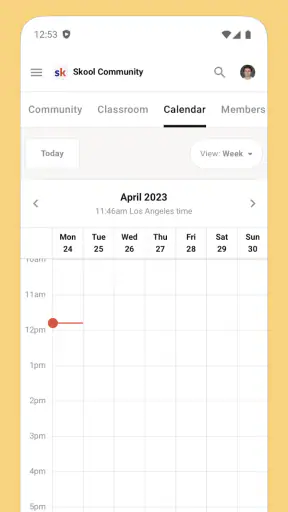
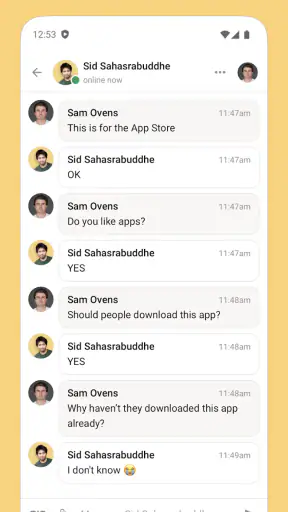
What stood out to me while using Skool is not that it tries to replace every social app on my phone. Its useful idea is narrower and more practical: it gives me a mobile way to stay involved in the Skool communities I already belong to. That focus changes how I judge it. I am not looking for a general-purpose feed, a messaging powerhouse, or an entertainment network. I am looking for a dependable community companion that helps me check in, follow discussions, and keep momentum when I am away from a computer.
That makes it an interesting choice in the social category, especially for people whose online groups are organized around learning, coaching, shared interests, or ongoing projects. The app is free, developed by skool.com, and aimed at Teen users. It has reached over a million installs and holds a 4.1 average from around 6,300 ratings, which suggests that plenty of people find the basic experience useful while still leaving room for mixed opinions.
I would describe the central capability as community access on the go. That sounds simple, but it has a real effect on how often I participate. Instead of treating a community as a website I need to remember to visit, the app puts it closer to the rest of my daily routine. I can check what is happening during a short break, respond when a conversation is still fresh, and return to a group without needing to sit down for a longer desktop session.
Why mobile community access matters here
The main strength of this app is continuity. A community can lose some of its value when participation depends on being at a laptop. I might read an update in the morning, think about replying later, and then forget by the time I have access to a larger screen. Having Skool on my phone reduces that gap. The app makes the community feel less like a separate destination and more like something I can keep up with in small pieces.
That does not mean every interaction becomes better on a phone. Long posts, detailed explanations, and careful reading can still be more comfortable on a larger display. The mobile format is strongest when I need awareness and quick participation: seeing what has changed, checking a discussion, or making a short contribution before moving on.
I also found that this kind of access works best when the community has a clear reason for existing. If a group is built around a course, a coaching relationship, a recurring challenge, or a shared goal, opening the app has an obvious purpose. I know what I am checking for. In a loose social feed, by contrast, I may scroll without a clear outcome. Skool feels more useful when the community itself has structure and members are expected to return.
That distinction is important for deciding whether it belongs on your phone. Someone searching for a broad social network with endless public discovery may find the experience too focused. Someone already connected to a specific Skool group may appreciate that the app keeps the relevant conversations in one place instead of scattering them across ordinary social platforms, group chats, and email.
What the experience feels like in daily use
My preferred way to use it is in short visits rather than one long session. I open the app to reconnect with a community, scan for anything that needs my attention, and decide whether I have something useful to add. That habit is more sustainable than promising myself I will catch up on everything at the weekend. The app supports a rhythm of small check-ins, which is exactly where its mobile form makes the most sense.
A realistic example would be a person following an online learning group while commuting or working between appointments. In the morning, they can see whether the group has posted a new prompt or update. At lunch, they can read a few responses and add a question. Later, they can return to see whether someone answered. None of those visits needs to become a major phone session, but together they keep the person involved.
The same pattern works for a community with an ongoing accountability element. If members are sharing progress, asking for feedback, or encouraging one another, quick access can make participation feel more immediate. I would not call the app a substitute for doing the underlying work, but it can reduce the friction between having an intention and showing up to the group where that intention is supported.
One useful habit is to treat the app as a place for decisions, not just consumption. After reading a discussion, I ask myself whether I should reply, save the idea mentally for later, or leave the app and act on it. That prevents the community from becoming another passive feed. The value comes from turning what I see into a question, a contribution, or a next step.
The best scenario for using it
The strongest scenario is a focused community that people revisit over time. Think of a group where the members already share context and where conversations build on previous activity. In that setting, mobile access is more than a convenience. It helps preserve the thread between sessions, which matters when progress depends on regular attention rather than a single visit.
I see particular value for members who are often away from a desk but still want to stay connected to a group. A phone is usually the device they have nearby, so the app can make participation possible in moments that would otherwise disappear. A five-minute check-in before an appointment may be enough to read a useful response or add a short update.
There is also a social benefit to reducing delayed replies. If I see a question while it is still active, I can answer while the context is clear. That can make a community feel more responsive. However, this depends on the quality and activity of the group itself. The app can make access easier, but it cannot create thoughtful discussions where the community has no clear purpose or members rarely contribute.
For organizers and community members, I would use the app alongside a more deliberate routine. A quick mobile visit is good for awareness and lightweight interaction. For planning, writing a detailed contribution, or reviewing a large amount of material, I would switch to a larger screen when possible. The trade-off is not a flaw unique to Skool; it is the normal compromise of doing community work on a phone.
Small workflow choices that improve the experience
My first tip is to decide what a successful check-in means before opening the app. It might be reading one important update, answering one question, or checking whether someone responded to me. Without that intention, even a focused community can turn into aimless scrolling. This is especially useful for people who already spend too much time in social apps.
My second tip is to write short replies when using the phone and save complex thoughts for a more comfortable session. A concise answer that moves a discussion forward is often more valuable than a long message written in a hurry. If a topic needs examples, careful wording, or several points, I would make a note and return when I can give it proper attention.
My third tip is to use the app as a bridge between community activity and offline action. If a post gives me an exercise, a task, or a question to consider, I try to leave the app and do that thing rather than immediately looking for another post. This is a non-obvious advantage of a focused community tool: it can support a routine, but only if I avoid confusing participation with progress.
A fourth practical point is to judge the app by the group you are joining, not only by the application itself. The same interface can feel valuable in an active, well-organized community and underwhelming in a quiet one. Before committing time, I would consider whether the group has conversations that match my goals and whether I actually want regular contact with its members.
Where the trade-offs become clear
The biggest limitation is that mobile convenience does not automatically equal depth. Reading and responding on a phone can be efficient, but it can also encourage quick reactions. If your reason for joining a community is serious study or detailed collaboration, you may still prefer a desktop browser for the heavier parts of the experience. I see the app as a companion for continuity, not a guarantee that every task will be equally comfortable on a small screen.
Another trade-off is focus. Because the app makes community access easy, it can also make it tempting to check repeatedly without a clear reason. That is not a problem if your group is central to your work or learning, but it may become distracting if you join many communities. I would be selective about which groups deserve regular attention rather than treating every update as urgent.
Skool is also not the obvious replacement for ordinary messaging apps. If my main need is a private, rapid conversation with one person, a dedicated messenger may be more direct. If I want a huge public audience and broad content discovery, a mainstream social network may offer more variety. If I need formal project management, shared documents, or structured workplace coordination, specialized tools are likely to be a better fit.
The app’s social value is tied to belonging somewhere specific. That is its strength and its boundary. It is more purposeful than a general feed when I have a community I care about, but it is less compelling if I am only looking for random content or casual browsing. I would not install it expecting the app alone to provide a complete social experience.
It is also worth keeping expectations realistic around the word “mobile.” An app can remove the need to open a browser, but it cannot remove the need to read, think, and contribute. If a community requires substantial effort, the phone makes access easier; it does not make the work effortless. I consider that a healthy limitation, because a community should support real progress rather than merely reward frequent checking.
Who will gain the most from it
I think Skool is best for people who already have a clear community destination. That includes members of learning groups, coaching communities, interest-based groups, and other online spaces where returning regularly has a purpose. The app is especially suitable for someone who wants to stay connected during the day without being tied to a computer.
It can also suit people who struggle with delayed participation. If you often read a useful discussion but forget to return later, mobile access may help you respond while the subject is still active. The benefit is not simply speed; it is preserving the habit of showing up. For communities based on accountability, that consistency can matter more than spending a long time inside the app.
I would be more cautious if you dislike community-based platforms, prefer completely private communication, or want a social app with a wide public discovery system. I would also skip it if I had no specific Skool community in mind. Without a group that matches your interests, the app has little reason to become part of your routine.
The app is free, which lowers the barrier to trying it, and its Teen content rating makes it relevant to a broad audience while still suggesting that users should approach community interactions with ordinary online judgment. It runs on devices using Android 9 or later. The current version is 1.0.57, so I would keep the app updated through the normal store process to benefit from the version intended for current users.
My recommendation after using it
I came away viewing Skool as a focused access tool rather than a universal social network. Its central capability—keeping communities within reach on a phone—has a genuine effect when I already care about the group and want to participate in small, regular moments. It makes the most sense when the community has ongoing conversations, shared goals, or a reason to return.
My recommendation is therefore conditional but positive. If someone invited you to a Skool community that supports something you are actively learning or working toward, I would try the app. Use it for quick awareness, timely replies, and maintaining a steady connection, then move to a larger screen when a discussion deserves more concentration. If you are searching for broad entertainment, private messaging, or a replacement for every other social tool, I would choose something designed specifically for that purpose instead.
In short, the app succeeds when it helps a meaningful community fit naturally into everyday life. Its value comes less from endless features and more from reducing the distance between the group and the moments when I can actually take part.


